

Tattoo Ink Blog - The Best Tattoo Ink of 2026: A Professional Artist’s Guide to Performance and Safety
Your client isn't just buying a piece of art; they're investing in a legacy that must remain vibrant until 2060. If your pigment fails to hold its saturation after the first six months, you aren't just losing a client, you're compromising your professional reputation. Finding the best tattoo ink in 2026 requires a ruthless commitment to both artistic soul and laboratory precision. You've likely dealt with the frustration of ink drying in the cup during a six-hour session or watching a pitch-black lining fade into a muddy blue. It's a common struggle that separates the hobbyist from the elite professional who demands perfection in every drop.
We understand that your craft is built on trust and the absolute safety of the people in your chair. As pioneers who've revolutionized the industry from the inside out, we're sharing the technical criteria that define world-class pigments. This guide explores everything from advanced pigment dispersion to the 2026 REACH safety protocols. You'll learn how to select sterile, vegan formulas that guarantee consistent saturation and long-term stability. We're breaking down the science to help you choose a "forever" brand and secure your place in the global community of elite professionals who refuse to settle for anything less than excellence.
Key Takeaways
- Master the objective metrics of pigment dispersion and flow rate to ensure your work maintains its vibrancy long after the skin has healed.
- Navigate the complexities of 2026 REACH compliance and learn how to verify safety data sheets to protect your clients and your professional reputation.
- Develop a precise selection framework for matching specific pigments to your signature style, from fine-line work to heavy solid packing.
- Discover why the best tattoo ink must balance scientific integrity with artistic heritage to serve as the permanent foundation of your creative legacy.
- Understand the intersection of color theory and skin physiology to achieve predictable, high-performance results across all skin types.
What Defines the 'Best' Tattoo Ink in 2026?
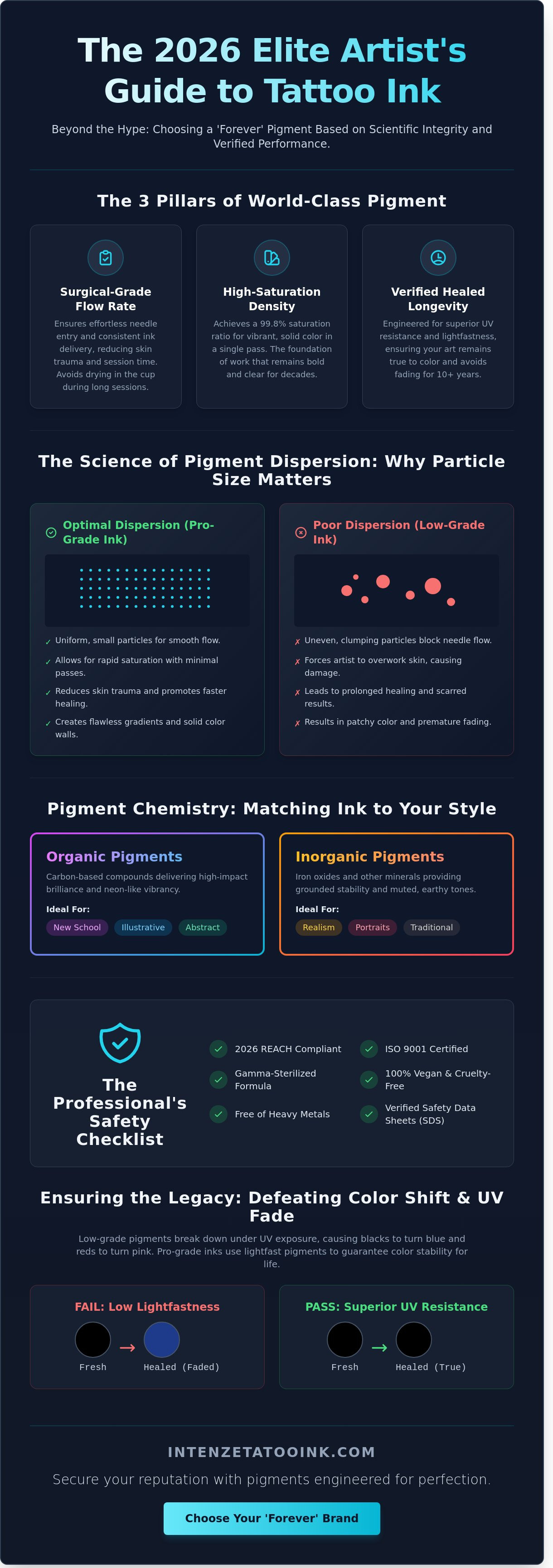
The industry has reached a definitive tipping point. In 2026, the era of choosing pigments based on social media trends or aesthetic packaging has ended. Professional artists now demand objective performance metrics over subjective popularity. To identify the best tattoo ink, you must look past the marketing hype and analyze the scientific integrity of the pigment dispersion. Quality in this new era is defined by three pillars: surgical-grade flow rate, high-saturation density, and verified healed longevity. This shift reflects a maturing industry where the rebellious spirit of the craft meets the precision of laboratory science.
Choosing a manufacturer with a 'for artists, by artists' philosophy is no longer a luxury; it is a necessity for professional survival. Since Mario Barth revolutionized the industry by introducing the first sterile, standardized pigments, the focus has shifted toward creating a legacy. When you select a pigment, you aren't just buying a supply. You are choosing the chemical foundation that will represent your name for decades. Understanding Tattoo Ink Composition is the first step in mastering how different pigments interact with various skin types and environmental factors.
Performance vs. Popularity: The Pro's Metric
Professional artists test for consistent pigment load by observing how a color holds its 99.8% saturation ratio across different batches. Workability describes the fluid dynamics of the ink as it leaves the needle. If an ink requires excessive passes to saturate, it increases skin trauma and prolongs healing. In 2026, genuine innovation is found in molecular stabilizing agents that ensure the best tattoo ink remains shelf-stable and vibrant without the use of harsh preservatives. Avoid the hype of "influencer brands" that lack rigorous ISO 9001 certification or REACH compliance.
The Longevity Factor: How Ink Ages
A tattoo that looks incredible on reveal day but fades within 24 months is a failure of chemistry. This "fall out" often occurs when low-grade pigments with poor lightfastness ratings are used. High-quality inks utilize pigments with superior UV resistance to prevent color shifting, such as blacks turning blue or reds turning pink over time. The relationship between pigment particle size and the body's immune response determines how much ink remains trapped in the dermis long-term. We define 'ink legacy' as the visual clarity of a tattoo 10 years post-procedure. Choosing the right material today ensures your artistic vision remains sharp and readable for a lifetime.
The Science of High-Performance Pigment Dispersion
Excellence in tattooing isn't accidental. It's engineered. The best tattoo ink relies on a precise balance of pigment chemistry and fluid dynamics. To the untrained eye, ink is just color in a bottle. To the professional, it's a complex suspension of solid particles within a liquid carrier. The chemistry of these carriers determines how the ink flows, how it heals, and how it stands the test of time. Modern formulations use a mix of distilled water, ethyl alcohol, and high-purity glycerin to ensure the pigment remains perfectly suspended without settling or drying out mid-session.
The choice between organic and inorganic pigments defines the visual outcome of your work. Organic pigments, which are carbon-based, deliver the high-impact brilliance and neon-like vibrancy required for New School or Illustrative styles. Inorganic pigments, often derived from iron oxides, provide the grounded stability and muted tones essential for Traditional or Realistic portraits. Choosing the best tattoo ink involves understanding how these chemical structures interact with human biology. Today, being vegan and cruelty-free is the industry baseline. Artists now demand pigments that are free from animal by-products and heavy metals, ensuring the work they leave behind is as ethical as it is beautiful.
Particle Size and Saturation Depth
Dispersion is everything when it comes to saturation. Smaller pigment particles allow for smoother gradients and faster saturation because they move through the tattoo machine's needle grouping with less resistance. When particles are too large or uneven, they cause clumping. This clumping forces you to overwork the skin, leading to unnecessary trauma and scarred healings. Intenze optimizes dispersion through proprietary milling processes, ensuring each particle is uniform. This technical precision allows the ink to fly into the skin, creating a solid wall of color that won't require a second pass. You can explore these advanced pigment formulations to see how science elevates your speed and accuracy.
Sterility and the Manufacturing Environment
Safety is the bedrock of your professional legacy. We manufacture our products in ISO-certified cleanrooms to prevent any possibility of cross-contamination. Every single bottle undergoes gamma radiation sterilization, which is the gold standard for eliminating microbial life without compromising the ink's chemical integrity. This level of rigor is vital for compliance with the FDA Tattoo Safety Guidelines, which warn against the dangers of unverified or "home-made" inks. Using unsterile products isn't just a health risk; it's a direct threat to your professional license. In an industry that is constantly evolving, sticking to laboratory-verified standards ensures your art remains safe for the lifetime of the client.
Navigating 2026 Safety Standards: REACH and Beyond
Choosing the best tattoo ink requires more than an eye for color; it demands a commitment to chemistry. The 2026 REACH standards aren't just hurdles for European artists. They represent a global shift toward total transparency. If you can't verify what's in your cap, you're gambling with your client's health and your own reputation. Safety isn't a secondary concern. It's the foundation of every masterpiece you'll ever create.
Every bottle of Intenze ink comes with a comprehensive Safety Data Sheet (SDS). You shouldn't just glance at these documents. You must verify the CAS numbers and check for the absence of prohibited preservatives and heavy metals. This level of scrutiny ensures that your art remains a permanent tribute rather than a medical liability. We provide the data because we've nothing to hide; our lab results are our badge of honor. To simplify your compliance journey, download our REACH SDS Verification Guide.
Many artists fear that safety comes at the cost of saturation. This is a dangerous myth. When we developed the Intenze Gen-Z line, we didn't just aim for compliance. We engineered a revolution. We proved that you can achieve world-class pigment dispersion and blindingly bright tones while exceeding the strictest safety thresholds on the planet. Your work stays vibrant because the science behind the pigment is superior, not because we've cut corners with unregulated chemicals. Ready to elevate your art with compliant, vibrant pigments? Shop Intenze Gen-Z Ink today.
Decoding the REACH Regulation
The 2026 ECHA guidelines target specific aromatic amines and heavy metals that were industry staples for decades. By January 2026, the European Chemicals Agency will have enforced even stricter limits on over 4,000 hazardous substances. Explaining this to skeptical clients builds massive trust. Tell them you use pigments that meet the highest international safety benchmarks. You're providing a product tested under ISO 9001 standards. This isn't about restriction; it's about the evolution of the craft.
The Global Standard for Professional Supplies
US-based artists are rapidly adopting these European standards to future-proof their careers. They know that what's legal today might be banned tomorrow. By choosing the best tattoo ink with a safety-first DNA, you're protecting your legacy and your clients. Transparency is the new currency of the tattoo world. If a manufacturer hides their ingredients, they're hiding a weakness. Learn How to Identify High-Quality Tattoo Ink to ensure your kit is up to the challenge. Professionalism means knowing your tools as well as you know your machine. Using the best tattoo ink isn't just a choice of material. It's an entry into a global community of elite professionals who refuse to settle for anything less than perfection.
Selection Framework: Matching Ink to Your Style
Mastery isn't a destination. It's a choice made with every dip of the needle. A "one size fits all" ink is a myth that limits your potential. Master-level artists understand that the best tattoo ink for a fine-line portrait is fundamentally different from the pigment required for heavy tribal saturation. You need a toolkit that respects the physics of the skin. Lining requires a specific viscosity to prevent blowouts; solid packing demands a high pigment load that stays put. Your choice of material must mirror the technical requirements of your specific genre.
Color theory in the skin is where science meets soul. Melanin acts as a biological filter. If you ignore how cool or warm undertones interact with your palette, your work will fade into a muddy memory. This is why artist-curated sets, such as the Bob Tyrrell Black and Grey set for Realism, are vital. These collections provide a pre-calculated spectrum of values based on decades of professional experience. They allow you to focus on the art rather than the chemistry of dilution. Using a system designed by a master ensures that your transitions remain smooth and your highlights stay crisp for years.
The Quest for the Perfect Black
Black is the foundation of every legacy. Choosing the right one depends on the task. Zuper Black is the industry benchmark for pitch-black saturation, providing a density that is unmatched for tribal work or large-scale fill. Conversely, Suluape Black offers the specific flow rate needed for traditional Polynesian tapping and intricate patterns. Using a professional grey wash set eliminates the dangerous guesswork of manual dilution. It ensures consistent values across multiple sessions, protecting the integrity of your transitions and ensuring the work heals exactly as intended.
Mastering Color Realism and Portraits
Realism demands a painterly approach. High-pigment loads allow for smooth gradients and the ability to layer colors without overworking the tissue. Gen-Z colors are essential for artists who require precise color matching, offering a palette that bridges the gap between digital reference and physical reality. This precision is what separates a standard portrait from a living masterpiece. To dive deeper into the science of pigment selection, check out our Mastering Tattoo Ink Colors: A Pro's Color Guide.
Your tools define your limits. Don't settle for mediocrity when your reputation is on the line. Shop the industry's most trusted best tattoo ink and elevate your craft today.
Why Intenze Remains the Professional Standard
Mario Barth didn't just start a company; he launched a movement. In the late 1990s, the industry lacked the consistency and safety protocols required for high-level artistry. Barth, a world-renowned artist with decades of experience since 1978, recognized that the best tattoo ink must be a marriage of artistic soul and clinical precision. He moved the production of pigment from backrooms into controlled laboratory environments, setting a new benchmark for the entire industry. This legacy of being on the front lines ensures that every bottle we produce meets the grueling demands of a ten-hour session.
Innovation at Intenze isn't a reaction to regulations; it's the catalyst for them. We pioneered the use of third-party sterilization and were the first to provide public access to Safety Data Sheets (SDS). Long before REACH compliance became a requirement in Europe, we were already refining our pigment dispersions to eliminate harmful heavy metals and ensure a 100% vegan, cruelty-free product. Our commitment to ISO 9001:2015 standards isn't just a badge on our website. It is a promise that the bottle you open today will perform exactly like the one you used five years ago.
The Black Label series represents the pinnacle of this technical evolution. Developed for the elite professional, this line offers an exclusive pigment load and a specific viscosity that allows for rapid saturation without traumatizing the skin. We also believe in lifting the entire industry. Through the Intenze Creative Academy and our global sponsorship programs, we provide the education and high-performance supplies necessary for the next generation to thrive. We don't just sell ink; we fuel the evolution of the craft.
The Intenze Difference: For Artists, By Artists
Our history as pioneers informs every formula we develop. We don't rely on generic chemical distributors. Instead, we engineer our pigments to ensure the highest possible lightfastness and stability. When you buy direct from us, you guarantee the authenticity and freshness of your supply. Counterfeit products are a growing danger in our industry, often containing industrial-grade carbon or unstable carriers. By choosing the source, you protect your clients and your reputation. It's time to stop settling for "good enough" and join the revolution of elite performance.
Building Your Legacy with the Best Tools
Your choice of ink is a direct reflection of your respect for the craft and your clients. A tattoo is a permanent legacy, and using inferior materials is a disservice to the skin that trusts you. Intenze checks every box for the best tattoo ink by providing unmatched vibrancy, rigorous safety testing, and a consistency that artists can rely on for decades. We provide the foundation. You provide the vision. Together, we create work that stands the test of time and heals with the clarity your art deserves.
Master the Future of Your Craft
Your art deserves a foundation that won't fade or fail under the pressure of time. In 2026, the standard for the best tattoo ink is defined by a relentless commitment to both pigment performance and biological safety. We've explored how advanced dispersion science ensures every drop hits the skin with maximum saturation and fluid consistency. You've seen why meeting REACH 2026 regulations isn't just a legal hurdle; it's a vital promise of longevity for your clients.
Intenze doesn't just follow these rules. Founded by Mario Barth, we pioneered the industry's first safety protocols decades ago. Our ISO 13485 certified manufacturing facility delivers medical-grade precision to your tattoo station every single day. When you choose a REACH 2026 compliant pigment, you're choosing a legacy built on scientific integrity and artistic soul. Don't settle for yesterday's standards when the future of the craft is already here. It's time to transform your vision into a permanent masterpiece with tools that match your ambition. Elevate your craft with the world's best professional tattoo ink. Your clients will see the difference, and your legacy will feel the impact.
Frequently Asked Questions
What is the best tattoo ink for staying black over time?
The best tattoo ink for a permanent, deep black is a high-load carbon pigment dispersion like Intenze Zuper Black. This formula provides a 100% stable saturation that resists the typical grey shift seen in inferior products. It's built on Mario Barth's 30 years of industry leadership. Your client's legacy depends on the ink staying as bold as the day it was hammered into the skin.
Is vegan tattoo ink actually better for the skin?
Vegan tattoo ink is better for the skin because it eliminates animal-derived ingredients like bone char and gelatin that often trigger inflammatory responses. By using 100% plant-based glycerin and organic pigments, we reduce the risk of adverse reactions. This scientific approach ensures a cleaner healing process for the 15% of clients who have sensitive skin or specific allergies to animal byproducts.
What does REACH compliant mean for tattoo artists in 2026?
REACH compliance refers to the European Union’s strict safety standards that banned over 4,000 hazardous substances in tattoo pigments starting in January 2022. For artists in 2026, this means using only tested, certified formulas that meet the latest Annex XVII requirements. Intenze led this revolution by being the first to develop a full range of compliant colors that don't sacrifice the vibrant saturation artists demand.
Can I mix different brands of tattoo ink?
You shouldn't mix different brands of tattoo ink because each manufacturer uses a proprietary blend of surfactants and carrier liquids that may not be chemically compatible. Mixing can lead to pigment clumping or uneven dispersion, which ruins the texture of your work. To maintain the highest safety standards and ensure predictable results, stick to a single ecosystem of products like our Gen-Z line for consistent performance.
How can I tell if my tattoo ink has expired?
You can tell your ink has expired by looking for the expiration date printed on the ISO 13485-certified label, which typically falls 2 to 5 years after the manufacture date. If the pigment has separated into a hard mass that won't redistribute after 60 seconds of shaking, the bottle is compromised. Using expired ink risks the sterility of your setup and can lead to poor pigment retention in the dermis.
Why does some tattoo ink fade to blue or green?
Tattoo ink fades to blue or green when the black pigment is composed of low-grade dyes rather than pure carbon. Over time, the body's immune system breaks down the smaller color particles first, leaving the stubborn blue or green base behind. High-quality formulas use concentrated carbon black to ensure the best tattoo ink remains true to its original tone even after decades of sun exposure.
What is the difference between lining and shading ink?
Lining ink is formulated with a higher pigment-to-carrier ratio to ensure it stays exactly where you put it without migrating. Shading ink, or grey wash, is a pre-thinned dispersion designed for smooth transitions and soft gradients. Professional artists use these distinct viscosities to achieve 100% precision in their work. Using the wrong consistency can cause blowouts or patchy gradients that compromise the final piece.
Is it safe to use UV or neon tattoo inks?
UV and neon tattoo inks are generally considered less safe because many contain Phosphorus or other reactive chemicals not approved for long-term subdermal use. Clinical reports have shown up to a 25% higher rate of skin irritation and photosensitivity with these specialty pigments. We prioritize your client's health and your professional reputation by focusing on high-performance, traditional pigments that have passed rigorous safety testing and ISO certifications.