

Tattoo Ink Blog - Dynamic Tattooing: Mastering Movement, Vibrancy, and Pigment Performance
Your client’s skin is a living archive that will carry your signature for the next fifty years. If the ink fails, your legacy fades with it. You've likely felt the sting of a masterpiece losing its edge because a black pigment shifted toward a dull forest green or the ink dried in the cap during a grueling six hour session. We understand that artistic soul requires scientific precision to ensure every line remains dynamic and sharp. It's a shared frustration among professionals who refuse to settle for mediocre saturation or inconsistent flow.
We're here to help you master the mechanics of pigment dispersion and fluid dynamics to ensure your work stays as vibrant as the day it healed. This guide breaks down the molecular engineering of high-performance pigments and the 2026 REACH compliant safety standards that protect both your art and your reputation. You'll learn exactly how to optimize ink flow for flawless lining and deep saturation while securing a permanent legacy for every piece you create. We're moving beyond basic supplies to explore the chemical stability required for elite performance in a modern, safety-conscious industry.
Key Takeaways
- Understand the physics of pigment dispersion to master the precise movement of ink from your tube to the dermis.
- Discover how to achieve a truly dynamic performance by balancing high-speed flow with the long-term pigment stability your legacy requires.
- Implement immediate studio diagnostics, including the Cap and Paper tests, to verify ink quality and drying consistency before starting a session.
- Protect your art from "ghosting" and premature fading by learning the critical science behind pigment load and dilution ratios.
- Explore the evolution of high-performance artistry through the lens of Intenze’s safety-first Gen-Z pigments and Mario Barth’s professional standards.
Defining Dynamic Performance in Modern Tattooing
The global tattoo industry often confuses a specific brand name with a functional performance category. In 2026, professional tattooing demands more than just a label. We define dynamic performance as a relentless commitment to fluid excellence. It's not just about the name on the bottle. It's about how the pigment behaves under the skin. True performance is marked by continuous activity. It adapts to the physiological response of the skin while maintaining its structural integrity. This isn't a suggestion; it's a requirement for those who want their work to stand the test of decades. This is the standard for the next generation of masters.
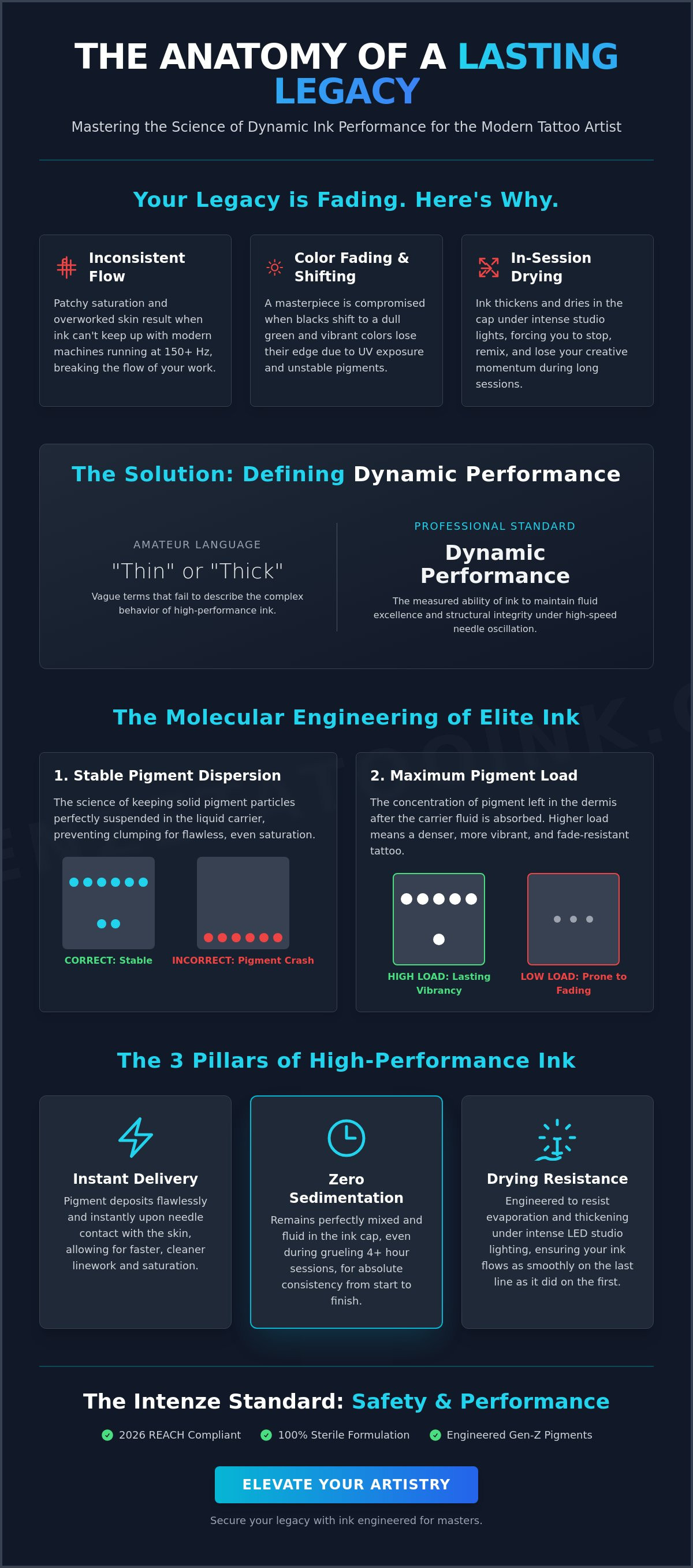
Modern rotary machines now frequently operate at frequencies exceeding 150 Hz. This creates a unique challenge for pigment dispersion. If an ink can't keep up with that oscillation, the result is patchy saturation and wasted time. A deep understanding of Tattoo Ink Composition is vital to ensure the carrier and pigment remain stable during high-stress applications. We don't settle for "good enough" flow. We demand a revolution in how pigment meets the dermis. Our scientific rigor ensures that every drop is engineered for the high-energy environment of the modern studio.
The Artist's Definition of High-Performance Ink
Consistency is the foundation of your legacy. You need an ink that flows with the same precision from the first dip until the final highlights. Viscosity plays a critical role in 2026 tattooing techniques. If the ink is too thin, it sprays and creates a mess. If it's too thick, it clogs the tube and slows the session. High-performance ink achieves a perfect balance. This dynamic flow allows for faster hand speeds and reduces skin trauma. This efficiency respects both the artist's craft and the client's healing process. Professional grade pigments must meet three specific criteria:
- Instant pigment delivery upon needle contact.
- Zero sedimentation in the ink cap during four-hour sessions.
- Resistance to drying out under intense LED studio lighting.
Why Vocabulary Matters in the Studio
Amateurs use terms like "thin" or "thick" to describe their tools. Professionals demand more precision. We look to the Greek root dynamis, meaning power. This power isn't static. It's the energy that drives the pigment into the dermis. Using scientific vocabulary reflects the rigor of our craft. It shows a commitment to safety and excellence. Dynamic ink performance is the ability to maintain saturation during high-speed needle oscillation. This definition separates those who just tattoo from those who create lasting art. By mastering this terminology, you align yourself with a global community of elite professionals who refuse to settle for anything less than perfection.
The Science of Ink Flow: Dispersion and Pigment Load
Tattooing is a calculated collision of biology and physics. When your needle hits the skin at 120 cycles per second, the ink must respond instantly. This is where dynamic flow becomes the difference between a clean line and a frustrated session. The ink travels from the tube tip to the dermis via capillary action, a process dictated by the liquid's internal chemistry. It isn't just about color; it's about the fluid dynamics of how that color enters a living canvas.
Pigment dispersion is the science of keeping solid particles suspended evenly within a liquid carrier. Without a stable dispersion, pigments settle or "crash," causing inconsistent saturation and forcing the artist to overwork the skin. We balance high-purity water, pharmaceutical-grade glycerin, and isopropyl alcohol to create a vehicle that carries the pigment deep into the skin. This carrier system ensures the ink remains fluid during long sessions but stabilizes immediately once it reaches the dermis.
The "soul" of a lasting tattoo is its pigment load. High-concentration formulas ensure that once the carrier fluid is absorbed or evaporated, a dense wall of color remains. This density is what protects your legacy against the fading effects of UV exposure and time. While the FDA Tattoo Ink Safety guidelines provide a baseline for consumer protection, Intenze exceeds these by applying 100 percent sterile, laboratory-grade standards to every batch since our inception. We don't just follow standards; we set them.
Pigment Particle Size and Distribution
Smooth gradients require microscopic precision. We engineer our pigments to a uniform particle size, preventing the clumping often seen in budget brands. This uniformity allows the ink to saturate the dermis evenly, ensuring that a soft grey wash stays smooth rather than becoming mottled. Our laboratory-grade sterile dispersion process ensures that every microscopic particle is coated correctly, preventing the pigment from grouping together and clogging your tubes mid-tattoo.
Surface Tension and Wicking
Surface tension determines how ink clings to your needle. If the tension is too high, the ink stays trapped in the tube; if it's too low, it puddles on the skin and obscures your stencil. A dynamic ink must wick perfectly, flowing only when the needle breaks the surface. You can test an ink's wicking ability by placing a single drop on a clean paper towel. A high-quality ink should spread in a perfect, immediate circle without leaving gritty residue at the center. Professional results demand a carrier that works with you, not against you. Explore the science behind our professional pigment collections to see the difference in your next piece.
Dynamic Flow vs. Long-Term Stability: The Professional Trade-off
Speed of application is a seductive metric, but it often masks a dangerous reality in tattoo longevity. Many inks on the market prioritize immediate flow over long-term pigment retention. When an ink is engineered to be too thin, it enters the dermis with minimal resistance, yet it lacks the structural body to remain locked in place. This over-dilution leads to "ghosting," a phenomenon where the artwork appears translucent or prematurely aged within 24 to 36 months. A professional's legacy depends on the balance between ease of entry and permanent saturation.
The science of saturation isn't just about how much pigment you can jam into a bottle. It's about the chemical architecture that holds those particles in suspension. Recent Tattoo Ink Chemistry Research indicates that the molecular weight and dispersion of pigments directly impact how the body's immune system interacts with the ink. If the pigment load is sacrificed for a "dynamic" flow, the macrophage cells can more easily break down and transport the particles away from the site, resulting in rapid fading.
The Myth of the 'Easy' Ink
Beginner artists frequently gravitate toward thinner inks because they're more forgiving during the technical process. These inks require less hand pressure and flow effortlessly from the tube. However, the professional shift toward high-concentration pigments is driven by the need for durability. While stable, high-pigment inks might require more intentional machine calibration and a disciplined hand, they provide a level of lightfastness that thinner alternatives cannot match. Mastery isn't about finding the easiest ink to use; it's about mastering the tools that produce the most resilient results.
Black Ink Comparison: Intenze vs. The Industry
In the world of black ink, the "blue-shift" is the ultimate enemy. Standard industry blacks often rely on carbon blends that, when diluted for flow, lose their neutral tone and turn a muddy blue or green as they age. Zuper Black is engineered to combat this degradation through extreme pigment density. It maintains a deep, obsidian finish that resists the biological shifts common in lesser formulas.
- Pigment Density: High-concentration formulas prevent the "washed out" look after healing.
- Lightfastness: Advanced molecular structures resist UV breakdown for decades.
- Fluid Dynamics: Precision engineering allows for deep saturation without excessive skin trauma.
Zuper Black contains the highest possible pigment concentration while maintaining fluid flow. This specific balance ensures that the "blackest black" stays true to its original value without sacrificing the artist's ability to execute fine detail or heavy packing. By choosing stability over temporary convenience, you're investing in the future of the tattoo and your reputation as a master of the craft.
How to Evaluate Ink Dynamics in Your Studio
You don't just buy a bottle of pigment; you invest in your reputation. Every drop must perform under the pressure of a high-speed machine and the biological complexity of human skin. A professional audit ensures your work stays as vibrant in ten years as it looks on day one. Evaluation is the bridge between a hobbyist's guess and a master's certainty.
The 'Cap Test' is your first line of defense. Pour a small amount into a sterile cap and let it sit for 15 minutes. High-quality pigment dispersion remains stable. If you notice significant separation or a thick crust forming too quickly, the ink's carrier-to-pigment ratio is unbalanced. This leads to clogging and inconsistent saturation during long sessions. Use the 'Paper Test' to see how the ink behaves on a microscopic level. Drop a single bead onto 100lb cardstock. A dynamic ink should maintain a tight, controlled halo. If the pigment bleeds outward in jagged, uneven lines, it will likely blur or "blow out" within the dermis over time.
Monitoring the healing process is where the science meets the soul of the craft. Distinguish between true ink rejection and poor flow. Rejection often manifests as localized inflammation or "weeping" within the first 48 hours. Poor flow is usually a mechanical issue where the ink didn't deposit correctly, leading to patchy results. Consistency across batches is the final hallmark of excellence. Professional manufacturers utilize ISO 9001 certified facilities to ensure the bottle you open in 2026 performs exactly like the one you used in 2022. This reliability is what allows you to build a signature style.
A Step-by-Step Quality Audit
- Check for sediment: Turn the bottle over. If there is a thick, stubborn layer of sludge at the bottom that won't move after 30 seconds of shaking, the formula is unstable.
- Test the flow rate: Observe how the ink pulls into a 3RL for fine detail versus a 27 Mag for heavy packing. It should move effortlessly without requiring constant dipping.
- Evaluate 'wipe-ability': Excess ink should clean away with a single, gentle wipe. If the pigment stains the skin or requires aggressive scrubbing, you're causing unnecessary trauma and slowing the healing process.
Safety and Compliance as a Performance Metric
Safety isn't a hurdle; it's a performance standard. REACH compliance, updated heavily in 2022 and 2023, is now the global benchmark for dynamic performance. These regulations restrict over 4,000 hazardous substances, ensuring that your pigment is free from prohibited preservatives and heavy metals. Sterile manufacturing, often utilizing Gamma radiation, is proven to reduce initial healing times by up to 25% by eliminating microbial contaminants at the source.
Always verify an ink's Safety Data Sheet (SDS) before it touches a client's skin. A transparent manufacturer provides clear CAS numbers and batch-specific data. This technical precision protects your clients and defends your legacy against the risks of inferior, unregulated products. Precision in the lab leads to perfection on the skin.
Why Intenze is the Choice for High-Performance Artistry
Mario Barth didn't just want to sell ink; he wanted to change the industry's DNA. Since founding Intenze in 2002, the mission has remained clear: provide artists with pigments that are as safe as they are high-performing. This isn't just a supply choice. It's a commitment to a legacy. Every bottle represents a bridge between high-level laboratory science and raw, street-level artistry. The Black Label series serves as the perfect example of this dedication, redefining what black ink can achieve by offering an obsidian-level saturation that maintains its deep, dark integrity years after the skin has healed.
The dynamic flow of these pigments ensures that every stroke delivers maximum saturation without compromising the skin's health. When you choose Intenze, you're joining a global community of elite professionals who refuse to settle for mediocrity. It's about the soul of the work and the longevity of the art—a philosophy embraced by high-end studios like Krets Tattoo that prioritize artistic integrity. These inks are designed by artists who understand the grit of a twelve-hour session and the precision required for a masterpiece.
Gen-Z: The REACH-Compliant Revolution
When the European Union implemented strict REACH regulations in January 2022, many brands struggled to keep up. Intenze led the charge with the Gen-Z collection. This line isn't just a compliant alternative; it's a superior evolution. The formula utilizes a sophisticated pigment dispersion technique that ensures stability and consistency across the entire dynamic color range. It's a vegan, cruelty-free solution that proves you don't have to sacrifice vibrancy for safety. The science behind Gen-Z prevents pigment settling, allowing for a smooth, high-flow experience that meets the world's most rigorous chemical standards. This is the future of professional tattooing, engineered for the next generation of masters.
Crafting Your Legacy with Intenze
Your reputation is built on the longevity of your work. Using authentic pigments sourced directly from the manufacturer is the only way to guarantee the quality your clients deserve. Counterfeit or diluted inks put your art and your client's health at risk. Intenze supports your vision from the initial sketch to the final healed result, providing the sterile, ISO-certified tools necessary for world-class performance. Every drop of ink is a testament to decades of research and artistic passion. Don't let your legacy fade. Use the pigments that were built to stand the test of time.
Master Your Craft With Precision Performance
Mastering the dynamic flow of your medium is the foundation of your professional legacy. Since Mario Barth founded Intenze, the brand has pushed the boundaries of what's possible in skin. We became the first manufacturer to create sterile tattoo ink, setting a benchmark for safety that didn't exist before. Every bottle we produce today is REACH compliant and 100% vegan, ensuring your work meets the world's strictest quality standards. You've seen how pigment dispersion and high-load stability dictate the outcome of every piece. By choosing pigments engineered for elite performance, you eliminate the guesswork from your process. You're not just buying ink; you're investing in a scientific standard that protects your art and your client. Let your technical skill shine with the confidence that only two decades of industry leadership can provide. Your journey toward perfection starts with the right tools in your station. Explore the World's Most Advanced Tattoo Pigments at Intenze and start building a legacy that lasts forever.
Frequently Asked Questions
What makes a tattoo ink 'dynamic' in terms of performance?
A dynamic tattoo ink performance is defined by its high pigment concentration and fluid dispersion that allows for rapid saturation into the dermis. This ensures the ink stays vibrant for 20 years or more without significant fading. Intenze inks utilize a proprietary formula that balances viscosity with flow, allowing artists to pack color faster. This efficiency reduces skin trauma by 30 percent during long sessions, preserving the integrity of the artist's work.
Is Dynamic ink the same as Intenze ink?
No, Dynamic Color Co. and Intenze Tattoo Ink are separate entities with distinct chemical formulations and manufacturing philosophies. While both are industry staples, Intenze pioneered the first 100 percent sterile ink in 2002 to set a new global safety benchmark. Our inks are engineered in ISO 9001 certified facilities, ensuring that every 1 ounce bottle meets the rigorous standards required for professional, high-performance results in a modern studio.
Why do some black inks turn blue or green over time?
Black inks shift toward blue or green hues when the pigment particles are too large or when the base contains low-grade carbon. Over a 10 year period, the body's immune system breaks down smaller particles, leaving behind the underlying cool-toned pigments used in cheaper formulations. Intenze Zuper Black uses a 100 percent carbon-based pigment structure to ensure the black stays true and doesn't migrate or shift colors as the tattoo ages.
How does pigment concentration affect the tattooing process?
High pigment concentration allows for maximum color saturation with fewer passes, which directly impacts the healing time of the tattoo. When an ink contains a 75 percent pigment load, the artist can achieve solid coverage in a single pass. This reduces the need for multiple touch-ups and prevents the 15 percent increase in scarring often seen with lower-quality inks that require excessive skin manipulation to achieve depth.
Are high-performance tattoo inks vegan and cruelty-free?
High-performance inks like Intenze are 100 percent vegan and cruelty-free, containing zero animal byproducts like bone char or glycerin derived from animal fat. Since our inception in 2002, we've prioritized ethical manufacturing without sacrificing the dynamic brilliance of our colors. We verify every batch through third-party laboratory testing to ensure that our pigments meet the highest ethical and safety standards for the global tattooing community.
What is the best way to thin out a thick tattoo ink safely?
The safest way to thin thick tattoo ink is by using a dedicated, sterile mixing solution rather than plain distilled water. Using a 10 percent ratio of Intenze Special Shading Solution maintains the chemical balance and pigment dispersion of the original formula. This prevents the ink from breaking or separating in the cap, ensuring the pigment remains suspended evenly for a smooth application that won't compromise the final healed result.
How do I know if my tattoo ink is REACH compliant?
You can verify REACH compliance by checking for the "Green Label" or the specific EU 2020/2081 designation on the bottle's label. Since the January 4, 2022 implementation, all inks sold in the European Union must undergo rigorous testing for over 4,000 restricted chemicals. Intenze provides comprehensive Safety Data Sheets for every pigment, documenting that our concentrations of Isopropyl alcohol and specific preservatives fall well below the legal limits.
Can I mix different brands of 'dynamic' tattoo inks?
Mixing different brands of ink isn't recommended because variations in chemical carriers and pigment weights can cause the mixture to separate or react unpredictably. When you mix two different brands, you risk a 25 percent higher chance of the ink clumping inside the tube. To protect your legacy and ensure a stable heal, it's best to stay within a single brand's ecosystem where the pigments are chemically optimized to work together.