

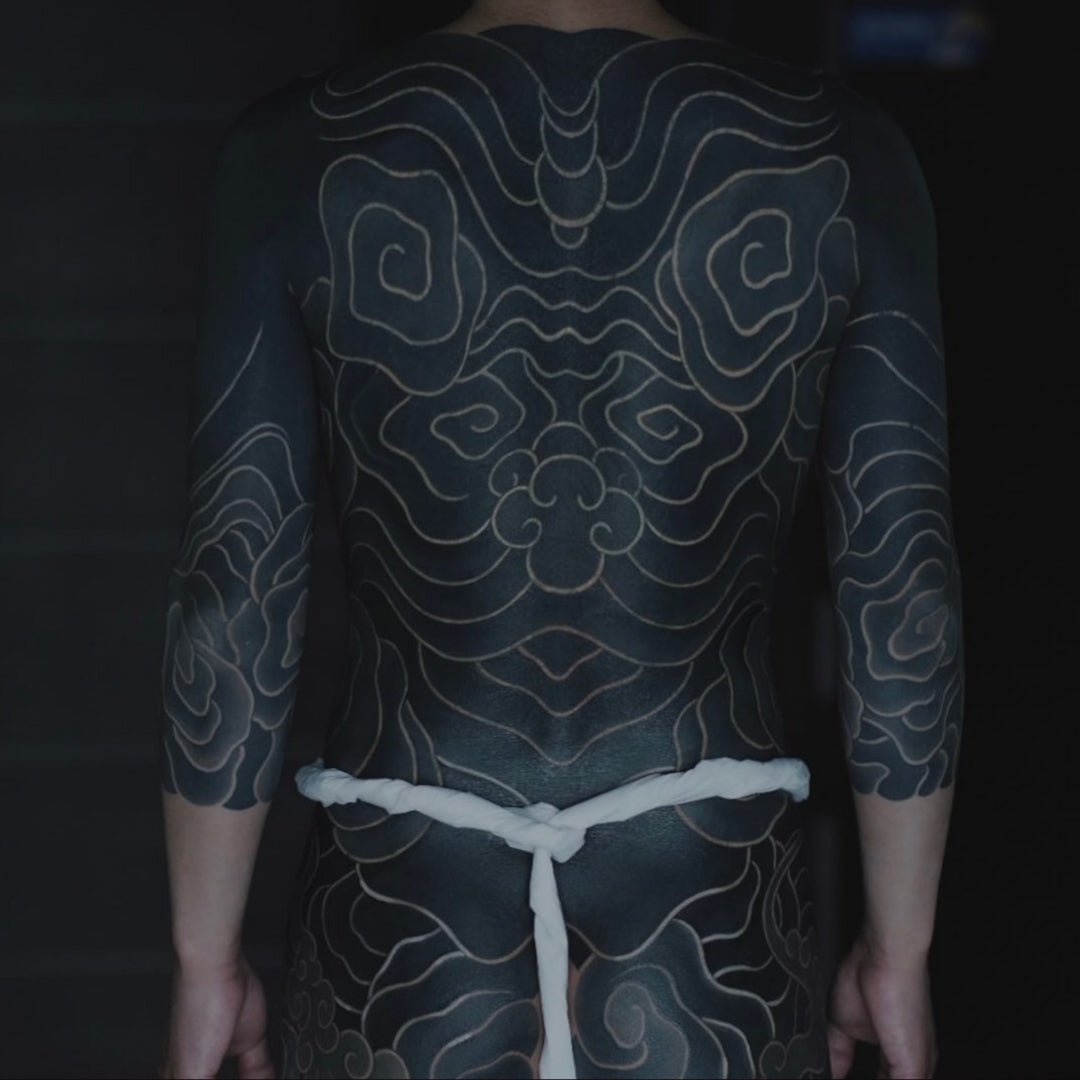
Black Sumi - Japanese Tattoo Ink
Japanese Tattoo Ink - Wash painting developed in China during the Tang Dynasty (618-907). Wang Wei is generally credited as the painter who applied color to existing ink and wash paintings.[1] The art was further developed into a more polished style during the Song Dynasty (960-1279). It was introduced to Korea shortly after China's discovery of the ink. Then, the Korean missionaries in Japan, in helping the Japanese establish a civilized settlement introduced it to Japan in the mid-14th century. In wash paintings, as in calligraphy, artists usually grind their own ink stick (Japanese: sumi) over an ink stone to obtain ink, but prepared inks are also available. Most ink sticks are made of either pine soot or oil soot combined with animal glue (Japanese: nikawa). An artist puts a few drops of water on an ink stone and grinds the ink stick in a circular motion until a smooth, black ink of the desired concentration is made. Prepared inks are usually of much lower quality. Sumi themselves are sometimes ornately decorated with landscapes or flowers in bas-relief and some are highlighted with gold.
Wash painting brushes are similar to the brushes used for calligraphy and are traditionally made from bamboo with goat, ox, horse, sheep, rabbit, marten, badger, deer, boar or wolf hair. The brush hairs are tapered to a fine point, a feature vital to the style of wash paintings.
Different brushes have different qualities. A small wolf-hair brush that is tapered to a fine point can deliver an even thin line of ink (much like a pen). A large wool brush (one variation called the big cloud) can hold a large volume of water and ink. When the big cloud brush rains down upon the paper, it delivers a graded swath of ink encompassing myriad shades of gray to black.
We used this historical aspects to create pigments graded for Japanese-style saturation to achieve those effects on skin.
Color map
tap a dot →Same color — lighter or deeper
Heals a dense black — stays black, never blue-grey.
Japanese wash — lays down smooth.
Thin with Shading Solution for a full grey ladder.
Customer Reviews
We live Intenze inks ! This black is amazing. ❤️❤️
Fluís, concentrated, easy to apply, excellent healing, neutral Sub tone, just perfect for me! thanks for developing a só good ink !!
About Black Sumi - Japanese Tattoo Ink
Japanese Tattoo Ink - Wash painting developed in China during the Tang Dynasty (618-907). Wang Wei is generally credited as the painter who applied color to existing ink and wash paintings.[1] The art was further developed into a more polished style during the Song Dynasty (960-1279). It was introduced to Korea shortly after China's discovery of the ink. Then, the Korean missionaries in Japan, in helping the Japanese establish a civilized settlement introduced it to Japan in the mid-14th century. In wash paintings, as in calligraphy, artists usually grind their own ink stick (Japanese: sumi) over an ink stone to obtain ink, but prepared inks are also available. Most ink sticks are made of either pine soot or oil soot combined with animal glue (Japanese: nikawa). An artist puts a few drops of water on an ink stone and grinds the ink stick in a circular motion until a smooth, black ink of the desired concentration is made. Prepared inks are usually of much lower quality. Sumi themselves are sometimes ornately decorated with landscapes or flowers in bas-relief and some are highlighted with gold.
Wash painting brushes are similar to the brushes used for calligraphy and are traditionally made from bamboo with goat, ox, horse, sheep, rabbit, marten, badger, deer, boar or wolf hair. The brush hairs are tapered to a fine point, a feature vital to the style of wash paintings.
Different brushes have different qualities. A small wolf-hair brush that is tapered to a fine point can deliver an even thin line of ink (much like a pen). A large wool brush (one variation called the big cloud) can hold a large volume of water and ink. When the big cloud brush rains down upon the paper, it delivers a graded swath of ink encompassing myriad shades of gray to black.
We used this historical aspects to create pigments graded for Japanese-style saturation to achieve those effects on skin.