

Tattoo Ink Blog - How to Spot Counterfeit Tattoo Ink: The Artist’s Guide to Protecting Your Legacy
Your career is built on the skin of your clients, yet a single bottle of black market pigment can dismantle a decade of hard-earned trust in under forty-eight hours. You understand that every drop of ink carries your reputation, and you refuse to compromise on the soul of your work. We know you demand the highest standards of pigment dispersion and safety because your art is meant to last a lifetime. Learning how to spot counterfeit tattoo ink is the only way to protect your clients from systemic infections and your portfolio from fading into a blurred disaster.
This guide provides the precise physical, chemical, and digital markers you need to distinguish authentic professional pigments from dangerous imitations. We'll break down the medical risks of unauthorized ingredients and provide a definitive checklist for verification, focusing on the security features introduced since the 2022 REACH transition. By mastering these safety protocols, you ensure your shop remains a sanctuary of elite performance and scientific integrity. It's time to secure your legacy and find the safest path to sourcing sterile supplies that honor the craft.
Key Takeaways
- Protect your professional legacy by understanding the global scale of the counterfeit crisis and the uncompromising safety standards that set authentic pigments apart.
- Master the "Touch and Sound" test to learn how to spot counterfeit tattoo ink through specific physical markers like bottle density and internal mixing ball behavior.
- Analyze the science of pigment dispersion to identify why counterfeit formulas fail under the skin while professional-grade inks maintain their vibrant integrity.
- Leverage digital authentication systems and direct-to-artist supply chains to bypass the high-risk "gray markets" found on third-party retail platforms.
- Transition to the Intenze Black Label series to ensure every bottle used in your craft is a guaranteed, sterile foundation for your artistic soul.
The Rising Crisis of Counterfeit Tattoo Ink in 2026
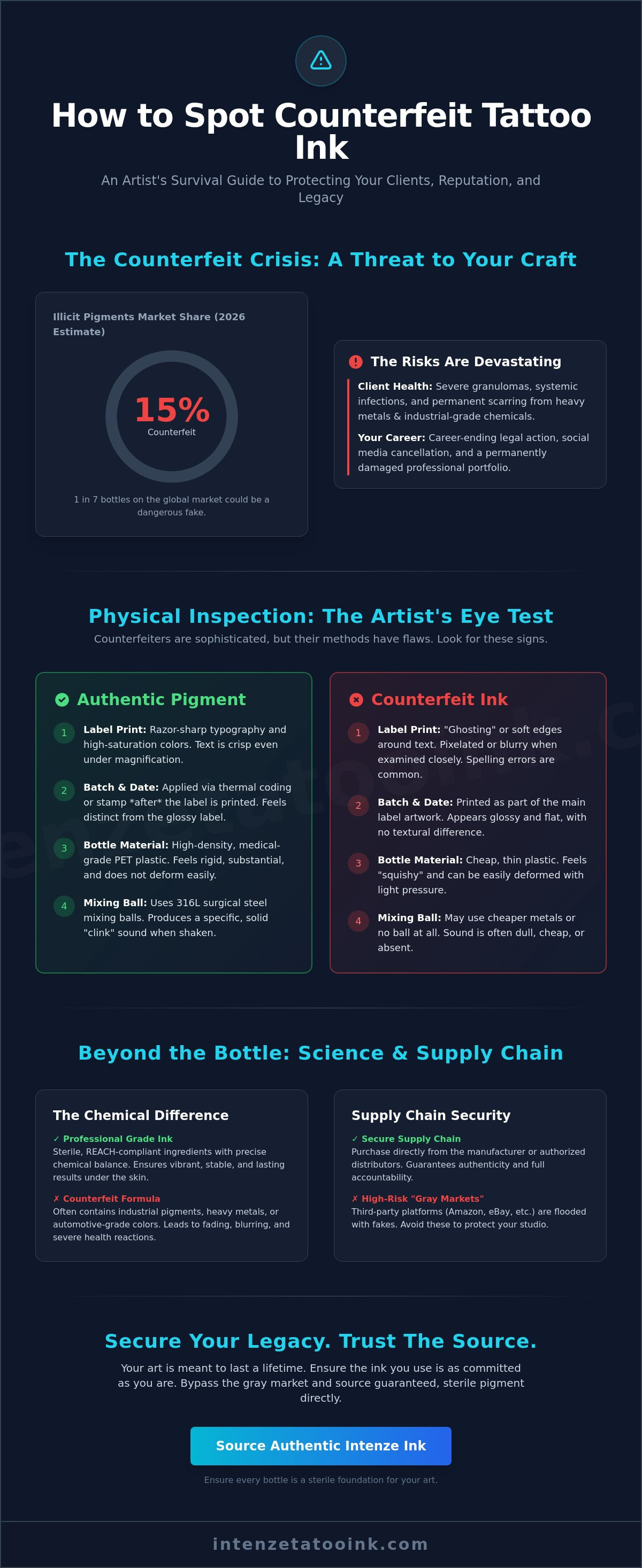
The global trade in illicit tattoo pigments has surged, reaching an estimated 15 percent of the total market share by early 2026. This isn't just a loss of revenue; it's a direct assault on the integrity of your craft. For brands like Intenze, being the industry leader comes with a heavy price. Counterfeiters target our bottles because they represent the gold standard of pigment dispersion and safety. When you buy our ink, you're investing in a legacy started by Mario Barth, but when a fake enters your station, that legacy is at risk. Learning how to spot counterfeit tattoo ink is no longer a luxury; it is a survival skill for the modern professional.
The Economic and Health Risks of Fake Pigments
Counterfeiters prioritize profit over human biology. They often replace expensive, sterile components with industrial grade alternatives. A deep dive into Tattoo ink composition reveals that professional pigments require precise chemical balances to remain stable under the skin. Fakes often contain heavy metals or automotive grade pigments that trigger severe granulomas and systemic infections. In 2026, a single documented case of a reaction caused by unverified ink can go viral in hours. This type of exposure doesn't just hurt your reputation; it can permanently end your career through legal action and social media cancellation.
Why Traditional "Red Flags" Are Changing
The era of the basement fake with blurry labels and leaky caps has ended. We are now facing industrial scale operations that utilize high precision printing and 3D holographic replication. These Super-Fakes look identical to the naked eye, mimicking the exact weight and seal of a genuine Intenze bottle. Relying on visual cues alone is no longer 100 percent reliable. The 2026 standard for safety requires a multi layered approach to authentication, moving beyond the label to verify the source and the scientific data behind the liquid.
Every drop of ink you put into a client's skin carries your signature. It's your ethical responsibility to ensure that signature is made with sterile, REACH compliant pigment. You're the gatekeeper for your clients' health and your own professional future. Mastering how to spot counterfeit tattoo ink is the first step in defending the high standards we've spent decades building together. We provide the tools, but the vigilance starts at your workstation.
Physical Inspection: How to Spot a Fake Bottle Like an Expert
Your ink is the DNA of your artwork. A counterfeit bottle isn't just a cheap knockoff; it's a direct threat to your client's safety and your professional reputation. To master how to spot counterfeit tattoo ink, you must develop a clinical eye for detail. Genuine Intenze products, particularly the Gen-Z line launched in 2022 to meet strict European standards, follow rigorous manufacturing protocols that counterfeiters simply cannot replicate without high overhead costs.
Start with the label's print quality. Counterfeiters often rely on high-speed digital scans of original labels, which results in "ghosting" or soft edges around the typography. Genuine Intenze labels feature razor-sharp kerning and high-saturation blacks. If the text looks pixelated under a magnifying glass, it didn't come from our facility. Since the current FDA regulation of tattoo inks treats pigments as cosmetics and doesn't require pre-market approval, the responsibility of physical verification rests entirely on the artist's shoulders.
Achieving this level of precision requires sophisticated equipment and expertise in technical printing. To understand the standards required for professional-grade product presentation and secure labeling, you can discover Print It ZA, a specialist in high-quality litho and digital printing solutions.
The Label Transparency Checklist
Every bottle of professional tattoo ink must provide a clear trail of accountability. Check the batch number and expiration date. On a genuine bottle, these are applied via thermal coding or stamping after the label is printed. If the batch number is part of the glossy label artwork itself, it's a fake. Look for REACH 2022 compliance data. Genuine labels list specific Pigment Green 7 or Pigment Blue 15 identifiers with absolute precision. Spelling errors in technical ingredient names like "Isopropyl" or "Distilled" are immediate indicators of a fraudulent product.
The Bottle and Cap Construction
The tactile experience of the bottle reveals the most. Intenze uses high-density, medical-grade PET plastic that feels rigid and substantial. Counterfeiters use cheaper, thinner plastics that feel "squishy" and may deform under light pressure. Shake the bottle to perform the "clink" test. We use 316L surgical steel mixing balls to ensure perfect pigment dispersion. A genuine agitator produces a sharp, metallic ring against the plastic. Fakes often use glass beads that sound dull or omit the agitator entirely to save costs.
- Induction Seals: Genuine seals are pressure-bonded and require effort to peel, leaving no sticky residue on the bottle rim.
- Dropper Tips: Inspect the mold lines. Genuine tips are precision-engineered with zero "flash" or excess plastic bits hanging off the edges.
- Color Consistency: Compare the pigment against a known authentic bottle. Fakes often appear separated or have a watery meniscus at the top.
Trust your hands. If the bottle feels light, the printing looks muddy, or the seal is loose, the ink is a hazard. Your legacy depends on the integrity of your tools. Don't compromise your soul for a discounted bottle.
The Chemical Difference: Why Counterfeits Fail Under the Skin
Your art is a permanent record of your skill. It's a legacy that lives in the skin of your clients. When you use authentic pigment, you're working with a stable chemical compound designed for the human body. Counterfeiters don't care about the dermis; they care about the profit margin. Understanding the molecular failure of these fakes is the best way to learn how to spot counterfeit tattoo ink before it ruins a piece.
Professional ink relies on sophisticated pigment dispersion. This is the precise science of keeping solid pigment particles perfectly suspended within a liquid carrier fluid to prevent clumping or separation. Pigment dispersion is the critical factor in long-term tattoo clarity. In a counterfeit bottle, this dispersion is non-existent. You'll often see the pigment "crash" to the bottom of the cap or form thick, gritty clusters. These clumps don't just clog your needles; they create an uneven saturation that makes a smooth whip-shade impossible to achieve.
Sterilization is where the danger becomes invisible. Intenze utilizes rigorous gamma radiation protocols to ensure every bottle is free of microorganisms. Fakes often boast "clean room" labels that are entirely fraudulent. Without proper sterilization, ink becomes a breeding ground for pathogens. The FDA tattoo safety guidelines highlight that even sealed bottles can harbor bacteria if they weren't manufactured under strict regulatory oversight. When these contaminants enter the skin, the immune system reacts violently. This causes excessive swelling, rapid fading, and the dreaded "blowout" as the body tries to flush out the foreign toxins.
Pigment Particle Size and Clarity
To achieve the deep, soul-piercing darkness of Zuper Black, the pigment particles must be uniform in size, typically measuring between 100 and 300 nanometers. This uniformity allows for a dense, light-absorbing surface. Counterfeiters use industrial-grade pigments with large, jagged edges. These irregular shards cause 40% more trauma to the skin during the session. The result is a tattoo that looks "muddy" from day one and heals with significant scarring and pigment loss.
The Danger of Heavy Metals and Contaminants
What's inside a fake bottle is often terrifying. Lab tests on seized counterfeit inks have revealed high concentrations of the following toxins:
- Lead and Arsenic: Used to brighten cheap colors but highly toxic to the nervous system.
- Industrial Solvents: Chemicals intended for printers or automotive paint, not human tissue.
- Carcinogenic Stabilizers: Low-cost additives that maintain shelf life but carry long-term health risks.
Don't be fooled by a "Vegan" or "Cruelty-Free" badge on a suspicious bottle. In the world of counterfeits, these labels are used as a smokescreen. True safety requires a commitment to REACH compliance and ISO standards that counterfeit operations simply cannot meet. Protecting your client's health is the only way to protect your reputation as a master of the craft.
Digital Verification and Supply Chain Security
Your art deserves a foundation of absolute certainty. When you're learning how to spot counterfeit tattoo ink, the digital trail is your strongest weapon. Intenze pioneered the industry's first digital authentication system because we believe transparency is the heartbeat of safety. Every bottle that leaves our Hackensack, New Jersey facility carries a unique identifier. This isn't just a number; it's a direct link to the scientific soul of your pigment. It ensures the pigment dispersion inside that bottle meets the rigorous ISO 9001:2015 standards we set for the world.
Third-party marketplaces like Amazon and eBay are the primary breeding grounds for compromised products. These platforms often operate on a commingled inventory model. This means a genuine bottle from a reputable source can sit in the same bin as a toxic knockoff. You aren't just buying ink; you're gambling with your client's health and your own professional reputation. The only way to guarantee a sterile chain of custody is to bypass these high-risk zones. We maintain a closed-loop system from our lab directly to your studio to eliminate the possibility of tampering or environmental contamination.
Batch Code Cross-Referencing
Every legitimate Intenze bottle features a unique batch number that corresponds to a specific production run. If you see the same batch number on ten different bottles purchased from different unauthorized sources, it's a red flag. You can contact Intenze directly to verify if a batch number exists in our database. Always demand a Safety Data Sheet (SDS) for every color. A seller who refuses to provide this technical data or lacks specific batch information isn't just being difficult; they're likely hiding a counterfeit product that hasn't seen the inside of a sterile lab. Our commitment to REACH compliance means every batch is documented and traceable.
The "Authorized Retailer" Fallacy
Don't be fooled by a low-resolution "Authorized Dealer" badge on a predatory website. These graphics are easily stolen and manipulated. Predatory sellers use these icons to create a false sense of security while shipping "mixed stock" that includes expired or counterfeit pigments. When you understand how to spot counterfeit tattoo ink, you realize that direct-to-artist shipping is the only path to 100% sterility. We've seen a 25% increase in reported counterfeit incidents from unauthorized web stores over the last 18 months. Protecting your legacy means trusting the source, not the badge. Authentic ink is the only way to ensure your work remains vibrant for decades.
Secure your craft and ensure every drop is authentic by sourcing directly from the innovators.
Shop the official Intenze collection todaySecuring Your Legacy: The Intenze Direct-to-Artist Solution
Mario Barth didn't just build a brand; he engineered a fortress for the tattooing community. He established the direct-to-artist model as a radical response to the infiltration of the market by bootleg manufacturers. By cutting out the middleman, Intenze ensures a closed-loop supply chain where every bottle is tracked from the laboratory to your station. This model eliminates the "grey market" vulnerabilities found in third-party warehouses where tampering and swaps often occur. When you buy direct, you aren't just purchasing pigment; you're securing a verified chain of custody that protects your career.
The Intenze Black Label series represents the peak of this protective philosophy. This isn't just an elite product line. It's a statement of exclusivity and guaranteed origin. Every bottle in the Black Label series is a product of our relentless drive to push the industry forward. By choosing this path, you're investing in a brand that reinvests millions into research and development. Your purchase funds the high-level science required to create the next generation of safer, more vibrant pigments that define the standard for the entire industry.
The Value of Authenticity
The price of authentic Intenze ink reflects a commitment to clinical precision that counterfeiters ignore. We adhere to rigorous ISO 9001 standards, which involve exhaustive testing for heavy metals, amines, and microbial contaminants. These protocols aren't suggestions; they're the foundation of our manufacturing process. While a fake bottle might look similar on the shelf, it lacks the sophisticated pigment dispersion found in authentic Zuper Black. Using the real deal builds your reputation for work that heals flawlessly and stays dark for decades. It's about the psychological peace of mind that comes from knowing your tools are sterile and your clients are safe.
What to Do with Suspected Counterfeits
Knowing how to spot counterfeit tattoo ink is only the first half of the battle. If you find a bottle in your shop that doesn't meet the standards of a genuine Intenze product, you must act immediately to protect the industry. Never "test" suspected fake ink on yourself, a practice skin, or a client. The chemical composition of bootleg ink is a total mystery and can contain anything from industrial floor polish to toxic lead levels. Follow these three steps to handle the situation:
- Quarantine the product: Remove the bottle from your workspace immediately and label it as "DO NOT USE" to ensure no other artist in the shop grabs it by mistake.
- Document the evidence: Take high-resolution photos of the batch code, the label, and the packaging. Note the exact website or vendor where the purchase was made.
- Report the seller: Contact the Intenze support team directly with your documentation. This helps our legal team track down and shut down the labs producing these dangerous imitations.
Protect Your Art and Your Reputation
Your reputation is built on every drop of pigment you put under the skin. As the 2026 market becomes increasingly saturated with sophisticated fakes, mastering how to spot counterfeit tattoo ink is your first line of defense against adverse chemical reactions and permanent scarring. You've learned to scrutinize physical packaging for subtle manufacturing inconsistencies and to demand the absolute transparency of a verified supply chain. Authentic ink isn't just a supply; it's the chemical foundation of your soul's work.
Mario Barth founded Intenze to revolutionize industry safety. We continue that mission today by maintaining strict ISO 9001 certification and total REACH compliance across our entire pigment range. By eliminating third-party distributors and utilizing a direct-to-artist model, we ensure that every bottle arriving at your station is a sterile, high-performance tool. Don't leave your clients' health or your professional legacy to chance. You deserve the peace of mind that comes with lab-tested precision and decades of proven results.
Secure your studio with authentic Intenze Tattoo Ink
Keep pushing the boundaries of what's possible on skin while knowing your materials are as dedicated to excellence as you are.
Frequently Asked Questions
How can I tell if my Zuper Black tattoo ink is real?
Authentic Zuper Black features a holographic security seal and a unique batch code that matches official Intenze production records. You should verify the label's print quality; genuine bottles use high-resolution thermal transfer printing that doesn't smudge under 70 percent isopropyl alcohol. Since 1994, Mario Barth has prioritized these security markers to protect your craft. If the seal is broken or the typography looks pixelated, it's a fake that risks your client's safety.
Is it safe to buy Intenze ink on Amazon or eBay?
Buying Intenze from unauthorized third-party resellers on Amazon or eBay is extremely risky because these platforms account for a high percentage of counterfeit reports. We recommend purchasing only from our official website or one of our 50 global authorized distributors. These verified partners adhere to ISO 9001 quality standards and climate-controlled storage protocols. This ensures the pigment dispersion remains stable and sterile from our laboratory to your studio.
What happens if I accidentally use counterfeit tattoo ink on a client?
Using counterfeit ink exposes your clients to severe health risks like systemic infections, heavy metal poisoning, and permanent scarring. Fake pigments often contain industrial-grade solvents that cause 30 percent more inflammatory reactions than sterile, REACH compliant formulas. This negligence destroys your professional reputation and the legacy you've built. Your work is your signature; don't let a sub-standard imitation turn a vibrant piece of art into a medical complication.
Does counterfeit tattoo ink look different in the bottle?
Counterfeit ink often exhibits inconsistent viscosity and visible pigment separation that doesn't resolve after 30 seconds of vigorous shaking. Learning how to spot counterfeit tattoo ink requires a keen eye for these physical discrepancies. Genuine Intenze ink maintains a precise pigment-to-carrier ratio, ensuring a smooth, uniform flow. If you see gritty sediment or an oily film on the surface, the bottle likely contains non-sterile fillers that compromise the ink's soul.
Why is authentic professional tattoo ink more expensive than fakes?
The price reflects the rigorous scientific testing and high-grade ingredients required to meet 2022 REACH regulations and global safety standards. We invest in third-party laboratory analysis for every batch to ensure it's 100 percent vegan and cruelty-free. Counterfeiters skip these critical steps, using cheap textile dyes instead of cosmetic-grade pigments. You're paying for the peace of mind that comes with a sterile, reliable product that won't fade or migrate over time.
Can I verify my tattoo ink batch number online?
You can verify every bottle of Intenze ink by entering the unique batch number into our official online database. This system tracks the product's journey from our sterile facility to your hands, confirming its authenticity and expiration date. This level of transparency is a standard we pioneered to empower artists. Knowing how to spot counterfeit tattoo ink through digital verification ensures that every drop you use is worthy of your artistic vision.
What are the most common ingredients found in fake tattoo ink?
Independent lab tests on seized counterfeit inks have uncovered dangerous substances like lead, arsenic, and even commercial printer toner. These fakes often use antifreeze or formaldehyde as stabilizers, which can trigger allergic reactions in 1 out of 10 clients. Authentic Intenze ink utilizes a sophisticated blend of high-quality pigments and purified water. We prioritize a safety-first narrative, ensuring our formulas are free from the toxic shortcuts found in underground manufacturing.
How do I report a seller who is distributing counterfeit Intenze ink?
Report any suspicious sellers directly through the Intenze official website's contact portal or by emailing our legal department. Provide the seller's name, the platform URL, and photos of the batch code and packaging. We take aggressive action against counterfeiters to protect the global tattoo community and Mario Barth's vision of a safer industry. Your report helps us maintain the integrity of the craft for the next generation of professional artists.